How to
How many security guards does your event need
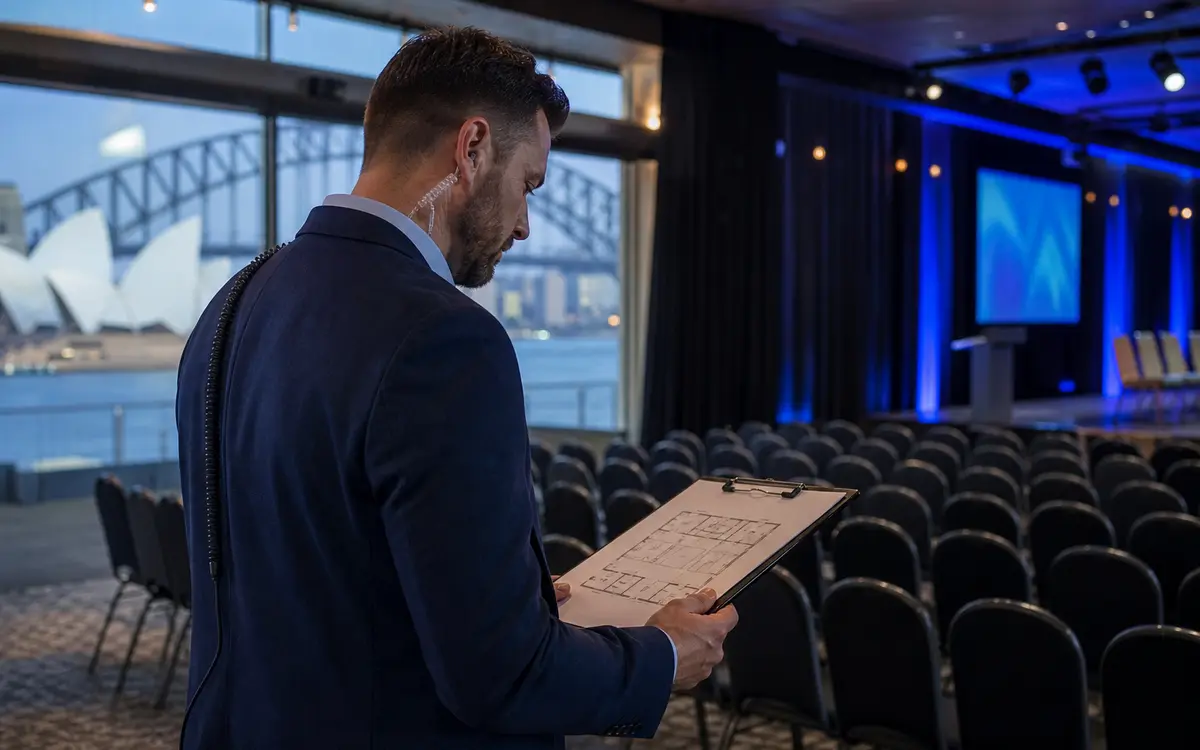
Who actually decides your guard numbers, the ratios the industry plans around, and worked examples for common Sydney events.
By Sydney Security QuotesReviewed
The short answer
Usually, somebody else has already decided. The venue's hire conditions, the council's event approval or the liquor licence conditions commonly specify security numbers, so read your paperwork before you count anything. Where nothing is prescribed, there is no general NSW ratio to fall back on, so planners use benchmarks. The one most often quoted comes from Victoria, where licensed venues are commonly required to have two crowd controllers for the first 100 patrons and one more for each extra 100 or part of 100. For events without alcohol, this guide starts from about one guard per 100 guests. Both numbers move up or down with risk, which is what the rest of this guide is for.
Step 1, read your approvals
Venue hire agreements, council event conditions and liquor licences override every rule of thumb. In NSW, single function and special event liquor licences also require that any security officers performing crowd control duties hold RSA certification alongside their security licence. If your event needs a licence, the conditions attached to it are your real security brief.
Step 2, count the risk factors
Each of these pushes numbers up from the baseline: alcohol service, ticketed entry with queues, cash on site, a late finish, an open site with multiple entry points, and a crowd profile skewed young. A 200 person daytime community fair and a 200 person 1am finish are not the same event, even though the headcount matches.
Step 3, mix the roles
Not every guard at an event does the same job. Crowd controllers manage entry, check IDs, refuse entry and deal with conflict, and they are the core of the team wherever alcohol and entry decisions are involved. Since June 2023 that work sits inside the NSW 1A Security Officer licence. General guards cover assets, access points, car parks and back of house. At licensed functions in NSW, security doing crowd control work also needs RSA. A good provider mixes the team to the event rather than quoting one flat role. See also party security and crowd control for the matching service hubs.
Step 4, count every hour
Security starts before your guests arrive and finishes after they leave. Bump-in, the event, the wind-down and the car park emptying all count, and the four hour minimum applies per guard. Most private events book to at least an hour past the advertised finish. Saturday and Sunday award rates apply to most event work because that is when events happen.
Worked examples, as starting points only
- A 60 guest 21st in a hired hall: venues commonly require two guards as a hire condition, and one guard is the floor for any private party at home
- A 300 guest licensed function: the Victorian benchmark points to four crowd controllers, before any risk factors move it
- A 500 person daytime community market, no alcohol: coverage is about entry points and assets rather than ratios, and two to three guards rotating is a common configuration
Treat these as the shape of the answer, not the answer. The provider confirms numbers against the venue, the licence and the crowd.
Step 5, book early
Two to four weeks out is comfortable for most events. Inside 48 hours is possible but priced with an urgency loading and fewer guards free, and event-heavy weekends book out.
What it will cost
Guard numbers times hours times the night's loadings, with the four hour minimum per guard. The cost guide covers the current Sydney rates, and the estimator turns your guest count, hours and timing into a realistic range in about a minute.
Ready to book? Event security in Sydney covers what to book and what it costs, and crowd control in Sydney covers door work when the venue or liquor licence sets the numbers.
Sources
- Victorian Government, Security at licensed venues (accessed 2026-11-15)
- NSW Government, Single function limited liquor licence (accessed 2026-11-15)
- NSW Government, Liquor and gaming competency cards (accessed 2026-11-15)
- NSW Police, Class 1 subclass changes from 1 June 2023 (accessed 2026-11-15)
Related
One minute to your quotation
Answer a few questions, get your number, and see what to confirm next.